
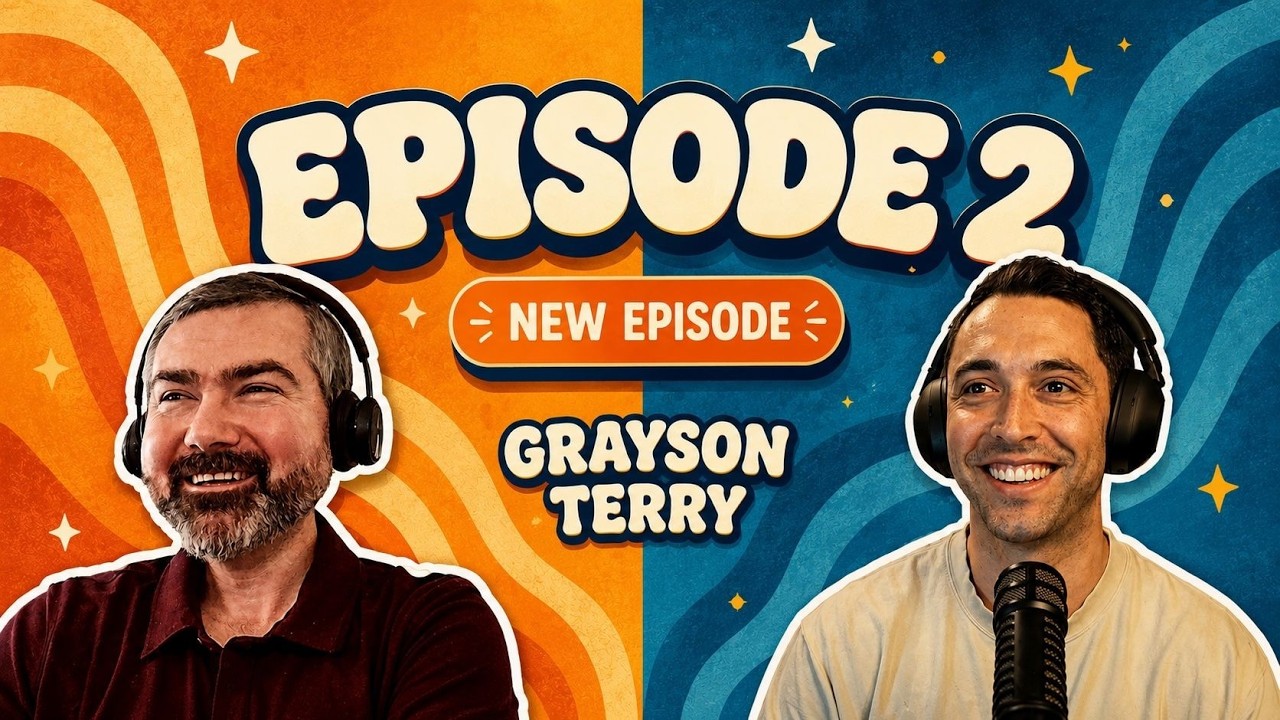
It’s Not the Job You Have
Grayson Terry on making sandwiches with excellence, the partner who wanted profit faster, and why he’d never burn a bridge.
Chapters
It’s not the job you have. It’s the job you do.
Don’t worry about where you start, because you’ll outperform everybody else along the way to where you finish.
You will get a bigger raving fan from a corrected problem than you ever will from always meeting somebody’s expectations.
It’s surprising how much easier it is now to be excellent.
Grayson Terry took a job making sandwiches because he had just been laid off from a fence company and needed the money. He was twenty-two, out of school, making $5.25 an hour, and working at four different Jersey Mike’s locations just to cover his bills.
Seven years later he was a multi-unit franchisee holding the largest contract Jersey Mike’s had ever written. This episode is about everything in between — the partner who bankrolled the growth and then wanted it faster, the businesses he ran after he sold out, and a line from his father that he had already heard a dozen times before it finally landed.
What we get into
- How a laid-off fence supervisor talked his way into four Jersey Mike’s kitchens, and then into a franchise agreement
- The profitability math: he promised break-even in eight months, the industry average is thirty-six, and the real answer was fourteen
- “It’s all a relationship game” — the through line he only spotted years after leaving
- Art versus science, and the labor-percentage argument with the financial partner who unlocked the biggest deal in the brand’s history
- Why a customer whose problem you fixed will out-advocate a customer you never once disappointed
- Food runner to assistant general manager in ninety days, and why starting on the ground floor was the whole point
- Off the record: a demotion that pushed his wedding back a year, the stubbornness behind it, and what AI is keeping him up about now
Resources
Transcript
“It felt like something I had spent a lot of time working towards was being taken from me a little bit.” — Grayson
Dane: Hello everyone, and welcome to another episode of The Franchise Groove, an official Jakiro podcast. Today I have with me Grayson Terry, who’s been in the franchising world for quite a while — getting his start back in 2004 at Jersey Mike’s, doing a brief stint at British Swim School, and now working with BIGGBY COFFEE as a franchise business consultant. Grayson, welcome.
Grayson: Thank you, Dane. Pleased to be here.
2004: from Jersey Mike’s crew to Jersey Mike’s franchisee
Dane: There’s a lot in that intro to unwrap, so let’s jump right in. 2004, with Jersey Mike’s — walk me through it. How did Jersey Mike’s come into your mind?
Grayson: Sure. Actually, believe it or not, I was working with a local franchisee, working at a number of their locations across the town I was living in at the time, and just became enamored with the brand — what they stood for, the way they executed. The metrics were all good, and I was like, I could probably run one of these. I don’t think this is outside of my scope.
So I began to look around, try to form partnerships and put together a team of people that could support me. Ultimately I had to go through the same approval process, even with the background of already working with one of their franchisees, and thankfully they said yes. And so off began my journey as a franchisee.
Dane: So walk me through that. You knew another franchisee, or a friend or a peer you’d worked with. Walk me through that relationship and that dynamic from the beginning.
Grayson: Sure. Like many young people, you start with your nearest circle of friends and family.
Dane: How old were you in ’04, if you don’t mind?
Grayson: Let me see — that would have been twenty-two, twenty-three. Yeah, is that right? Yeah.
Dane: Twenty-two. All right, so just out of school, college-ish. Did you go to college?
Grayson: Yeah, I did. I didn’t finish my degree — I’m one of those people. I went for electronic engineering at DeVry University.
Dane: Likewise.
Grayson: Similar interests, then, you and I.
Dane: Yeah, there we go. I can see why you got disenfranchised. I totally get it. It was not an easy major, for sure.
Grayson: No, no, definitely not. I enjoy math, but that’s a whole new level of number crunching.
Dane: It’s imaginary numbers. We’re doing the square root of negative one and just rolling with that. Negative one has a square root — go from there.
Grayson: Yeah, exactly. It’s all theory crafting. The answer itself is a question.
No, it kind of fell out of that, and I said, okay, I’ve probably got a different path forward than this degree. And so the Jersey Mike’s thing came along through happenstance — a bunch of different steps that took me there. I won’t get into all of those, but that’s where I landed.
So I reached out to my father. He had paid a number of visits to me there at the store, just when they were visiting in town, and he thought the same thing. He was like, this does appear to be a good investment. Let’s look into this, let’s go this route. And then, just to make sure that we sealed the deal and gave as much validity to our appeal to Jersey Mike’s to be a franchisee as possible, there was a local franchisee that I knew — not the ones I was working for, but he had a single store and had been in the business for a while — and we reached out to him just to be a third partner. That’s kind of where it began. His name was Martin, and we brought him along with his expertise, my experience in the store, as well as the financial backing. And so they were like, yeah, it’s a good deal, let’s do it.
And then you go through the long, rigorous process of market scouting to start with, and then site and location scouting within that. So that took another probably two years before we got to a place where store one was ready to go.
Dane: So you had been to a Jersey Mike’s before, I’m assuming.
Grayson: Yeah, so I had worked with a franchisee of Jersey Mike’s from about 2004 to about 2006 or 2007, which is when I decided I was interested in becoming a franchisee. They had about five locations in the town I was living in at the time, a small college town in North Carolina. And I ended up working at basically all of them, all the time. Eighty-hour weeks.
Dane: What were you doing? Were you making sandwiches?
Grayson: I was making sandwiches. I was effectively what they would call an assistant manager, or maybe a shift leader, depending on what store I was working at. I’d close the tills down, lock the doors, et cetera. There were a couple where I was more involved in scheduling and things like that.
Dane: Do you remember the first impression that Jersey Mike’s had on you? Because clearly that’s a pretty big decision to make. And of course you’re going to look into it — you said your dad sort of validated the more rational, number-crunching side — but there’s got to be some sort of emotional pull there for you to decide to do it. It can’t be all numbers, right?
Grayson: No, it certainly wasn’t. I only had probably a vague impression of how well they were doing financially, because I saw how busy they were and obviously they had multiple locations within the same town. But it was just fun. Part of it was certainly that I was working with a number of guys who were college age, just after college, and we had a great rapport, great camaraderie. We just really worked well together, and when we were all on the line together, that place was humming. There was just an energy that you don’t see when you go in many other places. And so I knew I could replicate that. That was certainly an appeal to me.
But meeting the customers, too — they deliver a great product. We had tons of regulars who came in multiple times a week, repeatedly, and it was just getting to chat with them and building out that level of confidence. Yeah, I was making sandwiches, but to have those conversations down the line, to be able to impress with the memorization of taking three, four, five orders with multiple modifications and somehow still putting them out while maintaining conversations — it was a fun thing. It was a challenge, but it was fun.
Dane: It sounds like it was both a technical appeal to you, from a motor-skills perspective, but also the social skills — you’re memorizing and you’re engaging in conversation with these folks who come in on a regular basis.
Grayson: Absolutely. I’ve never met a stranger, as they say in the South. I was always able to have a conversation with somebody, but this was a whole new level of that engagement — that rapid-fire small talk, keeping people excited as they were waiting for their lunch.
Dane: Had you seen that? I’m thinking about it, and I don’t know if I’ve gone into a sandwich shop before, as you describe it, and experienced that level of camaraderie and rapport. To me that strikes me as something pretty unique. Is that what also resonated with you?
Grayson: Definitely. I would say even to this day, outside of Jersey Mike’s — and not even all of those, I’m sad to say — I have not seen that level of engagement. The QSR restaurant model doesn’t normally lend itself to very happy people where they are.
Laid off from the fence company, knocking on doors at $5.25 an hour
Dane: Interesting. I know we kind of glossed over the intro, but I’m interested, if you don’t mind, in that first impression of when you walked in. Do you have a memory you could pull, or just an impression — was this before you had decided to work with them, when you were just a customer? Can you walk me through that? I’m interested in as gritty detail as you can.
Grayson: Sure. Well, I’ll tell you how I landed there, then. I undoubtedly had eaten there — it was very close to the apartment I lived in, so I’m sure I had already eaten lunch there at that point. But at the time I was actually a supervisor for a fence company, building fences in yards. And that company got purchased by another company who had their own supervisors, so they laid all of us off. And so very quickly I was in need of replacement income.
No shame in my game. I just went knocking on doors, walking down basically every shopping center that was nearby. And Jersey Mike’s hired me. It started off at fifteen hours a week. I think I was making like five and a quarter an hour at the time, and simply because I had to make way more money than that would allow, that’s how I started working at multiple of their locations. Just, hey, wherever you need me, I’ll go.
And that was sort of the draw-in: they were accommodating when they didn’t need to be, and they had no reason to be. They didn’t know me. I had no history with them. It wasn’t like I was best friends with the owner. It was just, hey, if you’re willing to work, we’ll put you to work, and we want to try to help you out in any way we can. And so that was the first sense of, there’s something different about this. You don’t know if that’s everywhere or just at those locations — it’s all based on the management, of course — but it was just like, wow, Jersey Mike’s now means something more to me personally than any other job I’d ever had, because of that.
Dane: Just thinking about it from somewhat of an outsider perspective, I don’t know if there’s a better success story — to turn someone who started working just an entry-level position into a business owner. I can’t think of a better situation, aside from perhaps one day going on to become the CEO and being like, you started working at a Jersey Mike’s. But regardless of that, it sounds like the culture they created there was so powerful that it created this almost torrential current of passion and interest and curiosity to continue investing in this ecosystem.
Grayson: Yeah, it was certainly a bit of a perfect storm for me — being sort of forced into that situation, having to inundate myself with their processes so quickly to be valuable enough that they would allow me to work at multiple locations, and then just somehow finding that I really, really enjoyed it. It all kind of came without me seeking it or looking for it. And the next natural step was, of course, to pursue doing something of my own.
But the culture of Jersey Mike’s sort of begins there as well, because the original — well, not the original original owner, but Peter Cancro, the guy who owned the company up until just a couple of years ago; I believe he just sold it recently — he was in high school working for Mike himself, and ended up getting a loan cosigned by his football coach to buy the first location that was open. It was just a passion that he developed in high school and he couldn’t get away from it. And the next thing you know, they’ve got multiple thousands of units, and the price tag they just sold it for is pretty astronomical. But that was kind of just built in. It’s the “you’re welcome here, do well, you’ll do well, and we’ve got opportunities if you want to pursue them.”
Dane: You had mentioned that they were quite accommodating. How soon did they see in you the ability to expand your impact and value generation? How quick was that?
Grayson: Yeah, I was there for probably about a month at the first location, just working a few shifts a week, picking up where I could. If somebody called out or needed the day off, I’d step in. So they started to see me at least as somebody who was going to show up on time. And of course I wasn’t in college either, so I wasn’t the typical college student — I didn’t go out and party late and not be able to make it in on time in the morning. That was something I think that showed through pretty quickly. They knew they could count on me, and then the moment that I needed it, they obviously had a need as well. So it was serving both sides. It was definitely dual purpose. But I’d say within a month, month and a half. It was pretty quick.
Dane: That’s quick. And so you start working there, and then you decide, all right, this is something I don’t just want to work in — I want to own one.
Grayson: Yeah. It’s a simple process in itself, Jersey Mike’s operations. You’re making sandwiches, you’ve got very few ingredients — a lot of combinations of a few ingredients are really what they’re built on. So its challenges didn’t necessarily lie in the execution of the model so much as in actually being able to build a successful business and manage a team of people. So it did take a little bit of the fear out of that.
I was pretty confident I could do the things I needed to do to manage the business well. The real challenges were probably going to come through building profitability quickly, being able to grow and scale. But in that regard I think it felt safe, and plus I knew it really well.
Dane: You had that insider perspective.
Grayson: I did.
Break even in eight months? The industry says thirty-six. It took fourteen.
Dane: How did those concerns — all right, I’m setting out now and we need to get to profitability — how did those match up? I’m sure you had some sort of expectation. Did you, in regard to what that timeline would look like? And how did that pan out, and how much did corporate help with that execution?
Grayson: Sure. Well, I was a number of firsts with Jersey Mike’s corporate coming along the way. So I had already started building up in my mind this “I can do it faster than everybody else can.” I would say my expectations were that we would be at break-even or profitable within six to eight months.
The likelihood for almost all QSRs is you’re looking at about thirty-six months before you’re there, depending on the loans and what you’ve actually had to take out versus what you were able to cover with your cash outflow. But we did it faster than thirty-six months. It was not as quick as the eight months that I had hoped.
It’s certainly a fear. We were coming into a brand-new market as well. There were no Jersey Mike’s around. We had the obvious competition at the time — there were Subways, and Zero’s Subs is common around the market that I’m in. And so you’re certainly worrying, can I break in? Am I going to be able to get people to deviate their traffic patterns to come and pay us a visit for lunch?
But I had no doubt, when I got done with my team put together, that we were going to have that same sense of energy and that same camaraderie, and that once you showed up you were going to come back. And they did. We grew our business pretty quickly, all things considered.
Dane: So what was that line you said — under thirty-six, but more than eight?
Grayson: The first location, we were sitting at about fourteen months before we would say that we were profitable. By that point we had location two open. I think we had the third one open by then — we might have been working on the third one. So that certainly helped a little bit, but the ownership structures were a little different as well. I wasn’t an owner in every location we ended up getting open, so I really just focused primarily on the ones I was directly involved in. I helped open all of them, I just didn’t necessarily have ownership in all of them. We got out of the gate, and by the time we got to the fourth and fifth location, we were pretty much bankrolling those right out of the profitability from the earlier locations.
Dane: When you first started, what did you think? I guess, to rephrase: what expectations did you have going in that ended up being — aside from the time duration — you have some vague idea of how this would roll out. I’m curious which one you were the most wrong about.
Grayson: As in which expectation? Probably — I think staff retention is something that I knew I’d be good at. I assumed that I’d be able to nail it the first try. You’d pick all the right people and they’d all stick around and they’d all love working for you. I did really well. I literally had staff members who were making basically just above minimum wage who were there for several years, just because of how much they enjoyed working there.
But there were of course plenty that, for various reasons, either didn’t work out for us and we had to terminate, or we weren’t working out for them — they needed far more than we could provide, so they had to move on. Some, just life changes take them to various places. So I would say I was really hopeful that we would be able to build out teams at every location that were incredibly long-lasting, that had that strong camaraderie like we had down in Greenville, North Carolina, and that people would stick around because they loved it. We’re not in a college town here, though, so there were a little bit different demands on a lot of our staff than what we had down in Greenville.
“It’s all a relationship game” — the through line he saw only later
Dane: And looking back, what would you say is an indelible impact that Jersey Mike’s has had, both professionally and personally? That’s a chapter that’s now behind you, which we can definitely touch on. But what has stayed with you?
Grayson: I think that regardless of what style of restaurant, or really even what kind of business, relationship building is one of the most critical pieces of anything you will ever participate in in your life. If you cannot build good, strong relationships, your chances of success go down to — it’s a non-zero number, but it’s pretty close to zero.
Dane: The relationships. How soon into working at Jersey Mike’s was that apparent to you?
Grayson: It was probably subconsciously apparent very early. I don’t think I drew the through line to it until much later, after leaving Jersey Mike’s, when I really started to look back and lay the pieces out and sort of noticed that every successful maneuver I’ve had has been because I knew somebody — and that somebody not only liked me, thankfully, but they trusted me and they respected me. And because of that, it made it very easy for them to trust that I could benefit them at their place of business. So I would say probably within several places after leaving Jersey Mike’s is when I really started to make that connection: this is all a relationship game.
Dane: That begs the question. I’m sure there are some pretty pivotal moments where the future of your trajectory, both within Jersey Mike’s and past it, hinged on a few relationships and some key moments. I’m wondering if any of those come to mind.
Grayson: Yeah, they do. I’ve actually got it mapped out so clearly in my head. Certainly the Jersey Mike’s one — having that relationship with Martin, and with the franchisees I worked for. They were a big advocate for me to get a store. Taking the people with me that I did, roommates that I had who were willing to go and work and help open locations, because they had confidence that I’d be able to do it.
But leaving there, I had an owner of a local QSR that used to come into Jersey Mike’s all the time. And when I did finally leave Jersey Mike’s, they were like, hey, we’ve been begging you forever to come work for us. Are you interested? I said yes, and took a job there. Another group ended up opening up another QSR and they wanted me to help run multiple operations for them. They had been customers of mine at that prior restaurant for a couple of years, and they were like, we want you to come run ours for us.
Leaving there, I had a friend who was working at a Ruth’s Chris Steak House as a server and told me they were hiring. He was like, you should come and apply here. And ninety days later I was the assistant general manager of Ruth’s Chris. So all of these things had been relationships from there.
I took over another operation that was cell phones. Somebody met me in Ruth’s Chris and was like, I need somebody with your interest and caliber of management and relationship-building skills to come and manage my private cigar club, fine dining restaurant, craft cocktail bar. And so I took that over for him.
And everything has been just this building on meeting people, getting to know people, adding value to their life. And then them, in turn — not always in turn, you won’t always get this back — but when an opportunity arises, they’re like, huh, who can I trust, and who do I feel comfortable working with? And thankfully I was that person in a number of decisions.
The biggest contract Jersey Mike’s had ever written — and the partner who came with it
Dane: Wow, some really interesting bookmarks there. So talk me through — as you’re on the tail end of working at Jersey Mike’s, I’m sure you didn’t know it at the time, but there were some internal machinations brewing. Walk me through that.
Grayson: Well, a couple of things. So we did have an additional partner that came along. He had quite a bit more financial backing — Jersey Mike’s actually put us together. And the idea was that with his much larger pocketbook, we could get a much larger contract. And so, like I told you, I was a first for Jersey Mike’s: they gave us the largest contract they’d ever done for Jersey Mike’s at the time. But it was my experience plus his financial backing.
And over time there was just a big separation of ideals, I think, with the actual business and where it was going and what needed to be a focus. I was very much the art and the science — it’s got to be both. He was from a banking background, so very much the science. And so we just didn’t see eye to eye, which is fine. Obviously I’m not sad where I am now. But at the end of the day, I was no longer the majority shareholder in the company, and so I was like, all right, somebody’s got to exit. This partnership isn’t going to continue to be beneficial to both of us. And so I sold out my shares and ended up leaving. That was the impetus for me to step aside and go into other businesses.
I would say it was building over time, though. I kind of knew where it was going. I was trying to make sure that I set everything up to leave it in good standing as I exited. And we exited on good enough terms. Certainly no bad blood between us or anything like that. But that was, again, relationship building. I don’t want anybody to be upset with me on the way out the door.
That was probably a disappointment when it first happened. I knew the decision needed to be made, but it felt like something I had spent a lot of time working towards was kind of being taken from me a little bit. And so I needed to rebuild that confidence a little bit. And over the next couple of operations where I was at, I was able to get that back and go, okay, you know what, I do know what I’m doing here. I can continue to replicate this and find my path forward. So, hopefully that answers your question — I think I’ve actually kind of gotten away from the question.
Art versus science: the labor-percentage fight, and Virginia’s scheduling minimums
Dane: No, I love it. I love it. I’m curious — as you said, you were more the art and the science, he was more the science, the finances. I can kind of guess at what that might look like, but I’m sure there were a handful of very ideal-value-clashing conversations, perhaps even arguments, that come to mind. What were those values at play, and where was the mismatch?
Grayson: Sure. Well, I was the boots-on-the-ground guy, and he was the financial backer. Obviously he was not working in the restaurants. Actually, he had been turned down for a franchise with Jersey Mike’s because he had none of the experience in the restaurants. That’s why they ended up putting us together — because we actually lived in the same town. That’s kind of how they were like, you should meet with this guy and see what happens.
The disparity came from — and this doesn’t mean that he was completely wrong or that I was completely right, or vice versa — but his banking background was very much: listen, if the Franchise Disclosure Document says that Jersey Mike’s on average operates at twenty-seven percent labor, we should be at twenty-seven percent labor. Well, being in the market and understanding that you’re still dealing, for the first year especially, with brand-new guests coming in, you don’t have any trends or patterns to reference back to and say, hey, how did we do the weekend before Fourth of July? How did we do leading up to Christmas? You don’t know what your scheduling needs are.
To go ahead and say I need to hit a financial target — that doesn’t mean you blow it out of the water and say forget about it, but to go after a financial target when you’re still growing the business, you’re still growing your market share, you’re still growing market awareness, you’re basically putting a ceiling on your earnings potential. And that was an argument he and I got into fairly often. It was like, listen, you’ve got to allow this thing to breathe, you’ve got to allow it to grow, you’ve got to allow it to be able to reach its full potential, and then we staff to its full potential. Because wherever you start staffing at now is where we’re going to stay. And I’d rather have eight percent of two hundred than ten percent of a hundred, right? Percentages don’t matter. You want a whole value number at the end of the day, and I’m trying to maximize that whole value number.
So that’s where a lot of it came into play. Obviously he was in a different state than I am right now, so labor laws were a little different. There was a lot of back and forth over that, and making sure that we stayed compliant. Little things.
Dane: Was that really an issue? My gut is that compliance was more a lever for trying to get the argument on one side or the other. I mean, I’m of course trying to be as unbiased as possible here — obviously you’re on the podcast and he isn’t — but it sounds like his lens was looking at a slice of the business in a very black-and-white fashion, whereas you, having gone and walked and worked not only on the floor but also at multiple locations, saw the big picture. Is that inaccurate?
Grayson: No, it’s not inaccurate. It might be a simplified way of stating it. A number of the compliance things often came down to labor laws, scheduling minimums in the state of Virginia. So say, for instance, for me to mandate that you show up for a shift in the state of Virginia, I have to schedule you for at least three hours. So if he sends over a schedule template and says, hey, I think this is how we cut labor, and I’ve got people that are scheduled for two hours, that puts us in a situation where I could put that schedule out, but then if you don’t show up, I have no recourse available to me. Legally I can’t hold you accountable for not showing up for that shift. So, educating him on those things that we were having to find out while I was here.
Charging people for shirts versus not charging them for uniforms — well, in Virginia, and this is actually a federal law, you can’t be paid less than minimum wage, right? Well, if we’re paying you minimum wage while you’re training and then I make you pay for a uniform, technically that reduces your actual wages. So now you’re being paid less than minimum wage. And so those kinds of arguments were cropping up, which is like, look, we can’t do that. I’m not going to find a workaround for that. That’s just silly. Little things like that.
Dane: And that’s in favor of your side. I was speculating it would be in favor of his, him being the number cruncher.
Grayson: The inverse, yeah.
Dane: Wow. Okay.
Grayson: He obviously wanted the numbers to get to a certain place, and I was often having to lean in and say, look, legally we can’t even do that. There are certain things you’re not familiar with, because you’re not in the state of Virginia and you don’t know what their labor laws are. So yeah, it was just back and forth like that.
And I mean, look, once he learned it, it wasn’t like he continued to try to snatch money out of old ladies’ purses or anything like that. I don’t think that he’s that kind of guy. But he obviously had a goal in mind as well. He ended up becoming the major financial backer. He wants return on that investment. I don’t begrudge him that. We just had a difference of opinion as to whether getting there faster was better, or getting further to profitability was better. And I think that was the biggest difference.
Dane: I think you just struck at the core tension that almost any business owner and operator faces when dealing with outside capital — especially in the world of VC and venture capital and tech, where you always have to grow as fast as you can. That’s the narrative. And then you have the founders who are putting their blood, sweat and tears into it and wanting to build something great. So there’s overlap there, but there’s always a tension, right?
Grayson: Definitely. Definitely. And it was a passion for me. It was certainly something that was near and dear to my heart. I definitely wanted it to be a legacy of sorts, and I wanted to set records and do things that Jersey Mike’s had never seen before. But I invited him in and said, basically — and this was my mistake — I’d rather do bigger, faster than the initial contract they offered me of just three locations, when it was myself, my father, and Martin. And because I invited that in and took what I thought was a shortcut, or maybe what I didn’t think of as a shortcut, it ultimately ended up making demands of me that, you know, somebody had to give.
“It’s not the job you have, it’s the job you do” — his father Ken’s advice
Dane: Wow. Very interesting. Incredibly interesting. So I guess, moving past Jersey Mike’s here — that’s been incredibly enlightening, thank you so much for all that detail. I love the story of it. I was out at a friend’s going-away party and was talking with a dog walker, and I’d never met a dog walker before. And I asked, how do you become a dog walker? Do people just randomly trust you? And it was just this series of events that happened where a friend of his had been a dog walker and needed help, and then he did really well, and it just sort of naturally occurred. I love those stories. It’s so beautiful.
And it definitely cuts against this narrative of all this individualization that we see, especially in Western culture, where all success seems to be just this white-knuckling of discipline and motivation and steadfastness to your goals through all obstacles. And while that can definitely get you success, and some people have attained success that way, I feel like it can be stifling to hold yourself to that, especially if something’s not working. And so I always love hearing different narratives that go counter to that — where these things sort of flew out naturally. There was no white-knuckling. This was all just passion and interest and diligence to your craft. You were working really well at Jersey Mike’s and you had these customers saying, I like what you’re doing, I like what you’re doing, come work with me. And you’re like, I don’t know. Not yet, not yet, not yet. And then the time finally came and you were like, well, hey, is that offer still open?
Grayson: Yeah. Sometimes you just answer the call. Sometimes you go after something with, like you said, discipline and focus and passion, and sometimes you just answer the call and you don’t know where it takes you. But I think I’m a firm believer that if you do everything with excellence, to the very best of your ability, then ultimately you’ll continue to succeed and do better.
And my father — I actually have to give him some credit. I didn’t mention this earlier, but obviously initially going into Jersey Mike’s as an employee: I was building fences, I was making good money, there were bonus opportunities. I had to go work at four different Jersey Mike’s to even come close to paying my bills. And so you get frustrated and you start getting a bit disenfranchised with where you are. And my father one day told me — he was like, what’s wrong? And I was like, I just feel like I’ve taken so many steps backwards. I’m making sandwiches, for God’s sake. And he was like, you know what? It’s not the job you have. It’s the job you do that you’re proud of. It could be anything, but at the end of the day, if you get to go home and say, I did the absolute best I could, you feel good about that. Doesn’t matter what your job title is.
And I don’t know why that piece of information at that moment clicked with me, when he’d probably told me that dozens of times before over the years. But that time it just sunk in, and all of a sudden I was like, you know what, he’s right. I’m making sandwiches. I’m going to be the best daggone sandwich maker that Jersey Mike’s has ever had. And I’d make the argument that for about seven years, I was pretty darn close.
Dane: I love that. That resonated so much with me. It’s so true. I get swept up in it myself with social media. I was just thinking earlier today, maybe I should just take a social media break. Being in the AI space, I get inundated with all these companies that are just blowing up, breaking all these revenue records, and I just think, wow. I should try to balance being excited for them while also not looking at it as some sort of standard to hold myself to. It’s very challenging. There’s a very knee-jerk response to do that. And that message from your dad — what’s your dad’s name?
Grayson: Ken.
Dane: Ken. Forever immortalized on the Groove, the Franchise Groove. I think that’s so incredibly powerful, because anywhere you are in life, whatever you do, that is so true. You don’t need to have this incredibly massive company, you don’t need to be a billionaire, trillionaire, whatever. You can make a delicious sandwich, and you really don’t know where or how well that delicious sandwich is going to affect the world. That’s something I’ve reflected on consistently — we always feel like we have this understanding of what our impact is in the world, but that’s so false. We couldn’t be more wrong. I can only imagine that a delicious sandwich, or one of the many that you’ve made, gave someone just a little extra pep in their step that day. They took that first bite and thought, this is really good. Wow, that’s a good sandwich. And that energy of that good sandwich propelled them into whatever their business was that day. And then you have this ripple effect of positivity and energy and self-expression that started with a first bite of a sandwich. And who knows — it could have created this massive reality that we’re unknowingly a part of, that we’re completely oblivious to. You never know.
Grayson: Absolutely. I think your energy certainly impacts those around you, and if you have an opportunity to give somebody a better experience today than they were having before they met you, I almost feel like you have an obligation and a responsibility to do it. And that just builds that relationship. And I still run into people — you’d be surprised. I still live in the same city now, and I run into people that I haven’t seen, as customers and as employees, from those Jersey Mike’s, in years and years. I haven’t been there since 2011, 2012. And they go, hey, Jersey Mike’s guy. They still remember, from a sandwich shop.
Dane: Yeah, there you go. Not just any sandwich shop, but Jersey Mike’s — the best.
Grayson: It was the best.
Dane: So you’ve gone through many restaurant industries. Looking through the notes here, you jumped around at Cooper’s Hawk, Ruth’s Chris Steak House, Bruegger’s Bagels. Walk me through some of the highlights, and also the lowlights, of working through those. And I think that’s the silver lining of the lowlights — what that’s taught you and empowered you to get to today.
Grayson: Sure. Absolutely. Well, obviously each of those are different concepts and they have different demands on your schedule. So the bagel shop was obviously very early morning. I was waking up at three a.m. every day to go to work, and my wife at the time was working evenings, so I’d get home just in time for her to head into work, and we’d maybe get a kiss on the way out the door kind of thing. And it was very demanding, because I was the general manager of those locations.
And then going into Ruth’s Chris, and eventually Twist — the concept I told you about with the cigar club, craft cocktails and fine dining — that was very late night. They were open later, a couple of them had bars, they were open late, and so then I was getting home at three or four in the morning. Complete opposite end of the spectrum.
And I’d say the one thing that I like about franchising that you won’t find with other concepts is that there are already established processes, operating procedures, to help you have the best chance of success. That tends to be the hardest part, I think, when people start something up that’s new. There is no standard to measure yourself against. You have to create that standard. And you have to take those thoughts and ideas and those repetitions and put them down on paper, and they have to be able to be executed by everybody. And most people don’t even know to start doing that, much less how to do it, if they ever figure out that they need to.
So I would certainly say this is a demanding industry, regardless of which field or restaurant type you fall into. It’s a lot of hours, especially in the beginning. It’s a big demand on your social life. Your holidays are not going to be yours. Your evenings are likely not going to be yours. And anytime you manage people, you’re always going to be in need twenty-four hours a day. Somebody’s going to be calling out. Somebody’s going to need something from you. Somebody’s going to have a request, a favor, a challenge that they need your help navigating.
If you’re going to do anything where you’re leading people, be ready to share some of your life with them. It will never be your own a hundred percent again. But it’s rewarding in a way that nothing else can be. And so I would say the lowlights are, it’s a lot, it demands a lot. But the highlights are definitely that you can have a lot of impact on a lot of people — staff, customers. And any challenge that you overcome inside of even something as simple as a restaurant, the tools and the mechanics are there to apply it in just about anything else. I ended up in consulting not because I was consulting for a restaurant group, but because I understood processes and how to make sure that those could be duplicated and taught and delegated. And that all came from restaurants.
The raving fan you only get from a problem you fixed
Dane: Interesting. What would you say was the unique flavor or spice of all of those? And not the industries, but the restaurants, the QSRs that you were at after Jersey Mike’s. Did they have their own unique flavor that caught you off guard, or that was interesting to you?
Grayson: I would say probably not that caught me off guard. Most of it — you know, eighty-five percent is the same in just about any restaurant that you manage, even from fine dining to QSR. But I will say that the consistency of how you deliver to a customer, meeting their experience, being the same — that was something that again I didn’t pick up at first. To go from Jersey Mike’s to Tijuana Flats and then to Bruegger’s Bagels — it took me a little bit before I recognized that through line of, executing on the guest expectation is pretty easy, and you just need to make sure that everybody is pointed towards the same goal.
What I did find out, and this is unique: you will get a bigger raving fan from a corrected problem than you ever will from always meeting somebody’s expectations. And that was curious to me. It took a number of examples for that to be true before I finally recognized it. If I have expectations and you always meet them, I’m going to walk away satisfied. But if I walk in and I get absolutely, completely disappointed in what happened today, and yet somehow you’re able to turn it around — I don’t know what it is about that dynamic. It’s that thin line between love and hate mechanism, I suppose. But you get that person happy and they will go tell everybody they ever meet about you, and advocate for you harder than anybody who ever came in and you always delivered for. It’s such a weird thing.
Dane: That’s fascinating. I was just reviewing my notes from the last episode we recorded, and Ash at Mathnasium had said the same thing. And he says that to his staff: mistakes are a big opportunity. So go and make mistakes, because when you can right the wrongs, to your point, those customers become champions now instead of just regular customers. Wow.
Grayson: Yeah. It’s an anomaly that I think only takes place in a service or retail industry. It’s very strange. But it’s true.
Into the deep end: a cold LinkedIn message and British Swim School
Dane: Well, I love that. So you eventually popped briefly out of fine dining and QSR into — or you swam, jumped in perhaps, we’ll use the pun — into the deep end.
Grayson: Into the deep end.
Dane: So what prompted that? And that’s how we know you, through British Swim School.
Grayson: Yeah. So this one was actually more a matter of circumstance than relationship building. I had actually left restaurants. I was kind of over and done. I made it all the way through COVID with Cooper’s Hawk. Still love them. They’ve got a great menu — if you haven’t eaten there before, please take advantage. Great, great food. But again, very demanding. And after COVID we started to see shrinking of the number of managers that were on staff, just across the board as a system. It wasn’t because they couldn’t hire. They were just like, well, we probably need fewer. Which made for bigger demands.
And so I was like, look, my wife has been putting up with this now since 2012. We started dating — she used to be a customer of mine at Jersey Mike’s, actually. So I asked her out the day that I sold and signed my shares over. So those coalign as well.
Dane: Wow. Wow.
Grayson: She’d been putting up with the changes in schedule and the demands for so very long, and I was like, you know what, I need to make a shift. I had been doing a bit of financial planning and consulting, just kind of on the side. So I was like, you know, I’m just going to go after this and do this for a while and see how things go, and I’ll get myself through Christmas to see how I’m feeling about it.
And one day I’m on LinkedIn doing a little bit of scouting — who can I reach out to to chat about financial planning and insurance, et cetera? And I spotted that the operations director had posted for a franchise business coach with British Swim School. And I was like, you know what, that’s actually kind of intriguing. I don’t even know what that is, but I’ve owned franchises, I’ve run, managed and operated businesses, and I am coaching people literally all day long at restaurants. I’ll reach out and see what this is all about.
And so I just directly messaged them, said, hey, here’s my email address, here’s my resume. I’d love to throw my hat in the ring and have a conversation with you and see what this is about. And we went through five or six weeks of interview back-and-forth conversations, and they ended up deciding I was a fit for the job. One of the biggest decision makers for them, they said, was the fact that I had owned a franchise, and none of the other coaches that they had at the time had. I don’t think many had even actually managed businesses. But certainly they had none that had ever owned — and they’re selling franchises, obviously. So you’ve got somebody who’s had financial investment up front, training, hiring, retention, staffing, customer relations and retention. And they thought at the very least it would lend a lot of credibility to my position as a new coach. And so they brought me in.
And that’s, long story, how we sort of got connected and met. But it took the passion I used to have from Jersey Mike’s and it took all of the hard things that I learned at Jersey Mike’s and kind of reframed them for me. And I thought to myself, you know what — I remember Christmas Day poring over P&Ls and invoices and inventory counts to try to rationalize where monies were going and what the numbers looked like and what projections should be, and doing that every holiday. And if I can save somebody else those sleepless nights, those headaches, those worries, those concerns, that’s a new pursuit for me now. I can help somebody else avoid maybe some of the worst parts of opening a business, and I’ll do it for British Swim School.
And so that opened up a whole new level of — or maybe a new room in this mansion that I didn’t realize existed. And I was like, wow, I like this. I could do this too.
Dane: Well, it sounds like you had an ability to look through the details, that you were very scrupulous in understanding not only the details but the big picture — going all the way back to the tension you had with the financier and saying, hey, the numbers aren’t crunching now, but I’m looking long-term here. I’m not looking just to the end of this year, or to this quarter.
Grayson: Yeah. And — sorry.
Dane: No, go ahead.
Grayson: It was a way for me to also take his perspective and tie it in together and say, listen, if you’re financing this yourself, obviously there is a time limit that we can work within. You have a certain amount of finances stashed away to support you up until you start making profit. I now need to figure out a way to help you work within the confines of that self-imposed time frame, and make sure that we’re hitting your targets and your goals.
And sometimes it’s just a matter of giving them a little bit of a pep talk. But sometimes it’s giving them hard facts and hard numbers and saying, listen, we’re winding down, we’re getting down to the limit here, and you have to make a decision. And that decision is either you’re going to have to ramp up your involvement and your energy and your activity, or we need to start putting together an exit plan and you need to find somebody else who can come take over what you started that you’re not going to be able to finish.
So yeah, I’d say what I learned from my financier actually played into that as well. He was a little ahead of schedule trying to get there, but he wasn’t wrong. He was just wrongly timed, I think, for it.
Dane: So walk me through — you accept this role as a franchise business coach at British Swim School and you’re starting to jump in on meetings and coaching sessions with franchisees. What’s going on in your mind on some of those first few calls?
Grayson: Well, I’m certainly concerned about whether they’re going to have any reason to trust me. What does this guy know? He was a restaurant manager, last we heard. So what can a restaurant manager teach me?
Dane: There it is.
Grayson: And trying to be able to take that and translate that language into: this is what I can help you with. And sometimes humbly coming in and saying, listen, I’m not going to know how to teach your kids better how to swim. I’m probably not going to know better how to negotiate your pool contracts yet — give me some time, I’ll figure that part out. But I can help you with a lot of things right now, even if only just to minimize your burden of time. Right? If you need something done, reach out, I’ll put it together for you and send it over.
And so a lot of the bridge building there really came from offering to do things for them that they probably felt like most coaches would have considered beneath them. And that was my way in the gate, saying, hey, listen, I need to learn the stuff that you know anyway. Allow me the opportunity to take the things I do know how to do and give you some benefit out of it. And then we just grew from there. And by the time I left, I actually had fifty-two franchisees that I supported. It was the largest in the company, by about a factor of two over most everybody. There was one guy, who our mutual friend knows quite well, who was doing nearly as many.
Dane: Wow. So it sounds like you were creating deliverables. You weren’t just giving perspective, you were actually getting your hands dirty with deliverables. What were those?
Grayson: It could be any number of things. I mean, obviously putting together financial reporting that they could take a look at and see what was going on. Building out projection tools that would cover them through the next three years. Automating some processes for them. I knew of various tools and software programs that I introduced some of them to — some for scheduling, some for just oversight with some of their Indeed hiring retention platforms. We did finally introduce some software tools system-wide to help with that a little bit later on.
Sometimes it was just as simple as, if you have any troubleshooting tickets that you’re putting in and somebody’s not getting to it fast enough, let me know. I’ll walk around the office and start tapping people on the shoulder. And you do that a couple of times and all of a sudden they’re like, well, at least he gets things done. And then you build the relationship up. But yeah, most of it was just tools and systems they didn’t have.
Food runner to assistant GM in ninety days at Ruth’s Chris
Dane: I love that. And that’s a theme I’ve seen throughout many business triumph stories — these operators working at a high level who started on the ground floor. And so there he goes, I’ll go tap someone on the shoulder. That’s Jersey Mike’s Grayson saying, all right, let me go grab the meat from the fridge. Let me just go and do what needs to get done. If I don’t know the best way forward here, let me just get the things that are on the list done first, and then I’ll work my way up to the high-level decisions and get those figured out.
Grayson: Yeah. And I’ve got a very specific memory that relates to that as well.
Dane: Please.
Grayson: So I told you I went from working at the bagel shop to Ruth’s Chris. Well, when I applied at Ruth’s Chris, I was just looking to make extra money, because my wife and I were working on getting married and we were paying for our wedding. So I got off of work at about two o’clock every day at the bagel shop, so I’ve got this whole evening I could make some additional money with. And so I applied at Ruth’s Chris to be a server. And they said, well, you have no serving experience. We can’t hire you to be a server.
And I was like, goodness, man, I’ve been managing restaurants, dealing with customers forever. I’ve got this. And they’re like, can’t do it. But we can hire you to be a food runner. And for those who aren’t familiar with what exactly that is: if you’ve ever been to Ruth’s Chris and had dinner, and somebody brings a tray out with the hot plates on it sizzling, and they’ve got the tray rack in their hand, and they set it down and start parceling out your meals — that’s that guy. They don’t get tipped out. They make an hourly wage and they’re just running hot plates filled with sizzling butter all day long.
Now, I’ve been a general manager, a franchise owner, et cetera, all up to this point. And he goes, I can hire you to be a food runner. And I was like, okay, well, how long does it take to go from being a food runner to being a server, on average? And he said, about six months usually. And I said, okay, I’ll do it in three. Again, overconfidence maybe. And he was like, okay, you’ll start October 1st.
And so October 1st, I took my first shift as a food runner at Ruth’s Chris. And then on December 12th of that same year, the assistant general manager who interviewed me, who hired me, pulled me aside and said, can I talk with you outside really quickly? And I’m like, well, yeah, sure. Hopefully I’m not being disciplined; I don’t think I’ve done anything wrong. He says, listen, tomorrow I’m putting in my two weeks’ notice. I’m going to take a general manager position at another restaurant, and I wanted to know: would you like to be my candidate for my replacement, my recommendation?
And I was like — it was out of the blue. Absolutely. He said, good, show up tomorrow with your resume. You’ll be the first to apply, you’ll go through the whole process, and we’ll see. But when I originally hired you, I was hoping that they would hire a third manager like we used to have, and I had the background for it. Which of course they didn’t — I was a food runner. But they ended up hiring me. I went through the whole interview process and was able to go directly from food runner to assistant general manager of the same restaurant, over the same servers who were barking at me all day long if I didn’t get the food out to their tables fast enough.
And that was because I was willing to go in on the ground floor and I didn’t let my pride or hubris get in the way. I was like, yeah, sure, I’ll do it. And I think maybe that’s a lesson for a lot of people too. If you’re confident that you can do well at what you’re about to do, don’t worry about where you start, because you’ll outperform everybody else along the way to where you finish.
Dane: Wow. If I could mic drop — do you have a mic handy? Just drop it.
Grayson: You do something with this one.
Dane: Wow. Wow. I love that. That’s so inspiring, too, because no matter where you are, in any position, roll up your sleeves and get the job done. And it’s going to get you forward.
Grayson: Yeah. Hard work does pay off. Persistent hard work pays off.
Dane: And the hard work in that regard is saying, I’m overqualified for this role, but I’ll do it anyway.
Grayson: Yeah. Glad I did. It was the next step to get here.
Off the Record: a sales call that slipped, and a demotion that delayed a wedding
Dane: Yeah. Wow, love that. I think this is a nice natural pause. We have a recurring session on The Franchise Groove where we go off the record and we talk about some things that didn’t go according to plan — we’ve touched on some already, but in a more formal format — and then what’s sort of keeping us up at night, so to speak. And I always kick things off. I’ll touch on one, a different one than last episode.
Grayson: Sure thing.
Dane: Something that didn’t go so well was a sales call. It fell through the cracks of our hands, or my hands — and who knows, it could still come through. But it was someone who was interested and ready to pilot and ready to go. And so I sort of went off script and said, all right, this is what we can do. Maybe we’ll do it this way, maybe we’ll do it that way. And then we sent out the plan moving forward, and didn’t hear anything. Haven’t heard anything. And we may reach back out at some point, but that was something where I thought, ah, shoot, maybe I should have stuck to my guns and gone through the regular process, regardless of how ready they may appear. So that was one.
And one that keeps me up — maybe not super keeping me up, but something that’s definitely back of mind a large majority of the time, always something I’m thinking about, and which is why I really enjoy and get value from filming these podcasts, even especially this one today — is balancing the growth with creating something great. And especially in the franchise ecosystem, something we both didn’t anticipate was how long that relationship process does take, and how long it does take to build trust. And that’s something that we certainly don’t want to circumnavigate, and something that we don’t want to do any worse than our utmost best. But we certainly didn’t know it would take as long as it has.
And so that’s something that we are constantly focusing on: how can we build and drive trust as robustly and efficiently as possible while never compromising on our values? And so maybe that’s a little too wordsmithed. It’s just, we are definitely feeling the itch to grow, but never compromising on the quality of the work that we do. And so stories like yours, Grayson, in all honesty are inspiring, because you show that you can just keep your nose to the grindstone, do the work well that you know you can do, and it’ll work out. It’ll work out and you’ll get it done. And so I love that. It’s helped me for sure.
Grayson: Yeah, excellent. Are you familiar with Alan Watts, by any chance?
Dane: I do, I do. I know the name.
Grayson: I have not read all of his work, but there was a video I saw that was quite inspiring, and it’s called “What If Money Were No Object?” He’s basically giving a lecture — he’s teaching at a college — and he says, what if money were no object? What would you pursue? And all the people give different answers, and hardly anything has to do with technology or grand pursuits of wealth or anything like that.
And he says, the thing is, if you can find something you love and you’re good at it, you’ll pursue it to mastery. You can only pursue something to mastery that you’re passionate about. But once you’ve mastered it, you can monetize it, and people will need what you have, because nobody else is a master of it. And you’ll get to exactly where you want to go without chasing money — but because you chased a passion and you learned it better than anybody else could.
And if you just stick with it, and you love it, and you can’t help but think about it — it keeps you up at night, but not in a bad way — you’ll master it. And then everybody is going to need your expertise, because who else would they ask?
Dane: Love that. So I guess I’ll flip that over to you, Grayson. What would you say is a big mess-up, and something that’s keeping you up?
Grayson: Yeah. Big mess-up — well, we’ve talked about picking the financier as a partner, so I won’t rehash that one. There was actually a small interlude during my journey, between Tijuana Flats and Bruegger’s Bagels, where I spent a brief while as a district manager at Oreck Sales and Service, vacuum cleaners.
The goal was that the prior district manager, who was a buddy of mine — it was a relationship opportunity — was going to be going to open a new franchise concept with that owner. And I spent about three or four months operating at that position, at that level, at that salary, and ultimately their franchise opportunity fell through.
And so the owner sat me down and said, hey, listen, unfortunately Josh has always been the acting district manager. We can’t really not give him the position back. I’ll have to demote you to a store manager. I was like, what about my pay? And he said, the pay kind of has to get demoted along with it. I can’t pay you a district manager’s salary just to do a single manager’s job. And those were six-day work weeks. It was Monday through Saturday every week. And again, as you’re trying to save up money — at that point I was just trying to ask my wife to marry me, I was trying to buy a ring. And that ended up being a big hit, and it took a while for me to finally agree to go back into QSR and to entertain a food opportunity again.
And that’s when, lo and behold, I ran into those guys who used to be my customers at Tijuana Flats, and they were like, we’ve been looking for you. We’re actually going to open up the Bruegger’s Bagels. Are you interested? And had they asked me at any time prior to them demoting me down to the manager level, I’d have said no, and probably even for a short while after. So I probably missed out on some good opportunities that I could have taken advantage of, had I just not been a bit stubborn about tapping back into something that I have a decent amount of expertise at and should have just leveraged all along. So that was the big mess-up. Because of that, we ended up getting married probably a year later than we should have. She doesn’t know that, though. Hopefully she doesn’t watch this podcast.
But as for what keeps me up at night: I think we’re in a very new and changing landscape with artificial intelligence. You touched on that. That’s something that’s going to impact just about everything that has a computer somewhere as an intermediary between you and the output. And I’m not fearful. It’s not one of those things where I’m like, oh no, I’m going to lose my job — that’s probably possible for anybody who’s doing something that uses a computer. I think my biggest thing right now is, how can I turn it into a strength and hopefully turn myself into an expert that other people will want to put on their team to help leverage this new tool? Because it is going to be brand new. It’s like learning to drive a tractor when everybody’s been using an ox and a plow, right? Who knows how to do this and do it well? So I’m hoping I’m going to be the guy who knows how to drive the tractor better than all the rest of my peers. And I think that’s something that I’m trying to pour as many hours into as I can, when available, to make sure I stay ahead of the curve, at least in my field, as much as I can.
Never burn a bridge — what he’d tell a young Grayson
Dane: Love that. That’s good. I’ve seen that persistent thread through all of your career: how can I build excellence? And regardless of what it is — all from creating sandwiches to now leveraging AI, almost the opposite side of the spectrum in terms of complexity — it’s still that same recurring motif and driving factor. How can I become really great?
Wow. Beautiful. So I think we’re right at the hour here. A way I like to wrap is: what would you tell a young Grayson who wasn’t feeling on top of the world? And I have some inclinations, but of course the floor is yours. What would you tell a young Grayson who’s not feeling on top of the world, to help him get back up on his feet and keep playing?
Grayson: Sure. Probably the same advice my father gave me would be one of the most important things. At the end of the day, what you have accomplished — you shouldn’t value it based off of the job title that it’s associated with. It’s just, how well do you do that job? Did you give it everything you had? Did you do it the best that you possibly could? And if you continue to do that, whatever you’re doing, people will notice.
It’s surprising how much easier it is now to be excellent, because so many of your peers have no care to be excellent. They just want to do enough to get by. And if you’ll just continue to do everything you can to be excellent, you will stand out and you will get found, and somebody will give you an opportunity.
And whatever you do, under no circumstances — whether it’s your financial partner who has ruined your dream, not really his fault, or just somebody who happened to cause you to have a bad day that day — do not ever burn a bridge. Under any circumstances.
Dane: Wow. Wise and resonant words from the one and only Grayson Terry. Grayson, it’s been a sincere pleasure. Thank you so much for coming on The Franchise Groove and for sharing with us all of your wonderful stories.
Grayson: Certainly, Dane. The pleasure’s been all mine.
Dane: Wonderful. And folks, thanks for listening. We’ll see you guys on the next one. Take care. Bye bye.
Grayson: Take care.